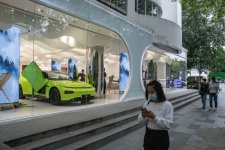
(Bloomberg) -- A late-2024 sales boom for Chinese EV manufacturers, led by BYD Co., is expected to be followed by another brutal year as automakers deal with threats to domestic and international demand.
Last year, industry titan BYD shipped a record 4.27 million electric vehicles and plug-in hybrids. In the meantime, Stellantis NV partner Leapmotor doubled sales to over 293,700, and Li Auto Inc. delivered over 500,000 cars.
Despite the year-end increase in demand, other well-known brands, such as Nio Inc. and Xpeng Inc., failed to meet their goals. Sales of Zeekr, a high-end electric vehicle brand owned by Zhejiang Geely Holding Group Co., increased 87% to 222,123 last year, falling short of the 230,000 target. 2.18 million cars were delivered by the larger Geely auto group, which includes its namesake brand. This represents a 32% increase from the previous year.
The conflicting findings portend yet another year of intense competition for the largest automobile market in the world, which has seen a never-ending price war that has seen major manufacturers gain market share while smaller competitors are driven to the edge. China's EV exports have been negatively impacted by rising trade tensions with important trading partners like the European Union. To boost domestic sales, the nation's leading industry group has urged the government to provide concessions for trading in older vehicles.
Notwithstanding the better-than-expected 2024 outcome, those uncertainties are casting a shadow over the beginning of 2025. According to Cui Dongshu, secretary general of the Passenger Car Association of China, the country's total passenger car retail sales may rise by only 2% to 23.4 million vehicles in 2025, after growing by 5.7% the previous year.
"More established automakers like Geely and BYD have rebounded, and this momentum may continue in 2025, along with strong growth from companies like Xiaomi," he mentioned. "Geopolitical concerns are putting more pressure on exports, so domestic sales are anticipated to become more significant."
This will probably increase the pressure on Chinese automakers to introduce more recent models or technologically advanced products that appeal to the nation's increasingly discerning consumers.
Last year, a total of 444,000 cars were delivered by brands that are part of Huawei Technologies Co.'s Harmony Intelligent Mobility Alliance, including Aito. With an SUV set to debut this year, Xiaomi Corp. Chairman Lei Jun announced that the company's EV division's sales target will be increased to 300,000 for 2025 after surpassing its initial delivery target of 100,000 electric SU7 sedans.
Additionally, legacy automakers run the risk of losing more market share. Deliveries from Guangzhou Automobile Group Co., a partner of Toyota Motor Corp., and SAIC Motor Corp., a state-owned partner of Volkswagen AG, are predicted to drop by 20% in 2024.
Last year, industry titan BYD shipped a record 4.27 million electric vehicles and plug-in hybrids. In the meantime, Stellantis NV partner Leapmotor doubled sales to over 293,700, and Li Auto Inc. delivered over 500,000 cars.
Despite the year-end increase in demand, other well-known brands, such as Nio Inc. and Xpeng Inc., failed to meet their goals. Sales of Zeekr, a high-end electric vehicle brand owned by Zhejiang Geely Holding Group Co., increased 87% to 222,123 last year, falling short of the 230,000 target. 2.18 million cars were delivered by the larger Geely auto group, which includes its namesake brand. This represents a 32% increase from the previous year.
The conflicting findings portend yet another year of intense competition for the largest automobile market in the world, which has seen a never-ending price war that has seen major manufacturers gain market share while smaller competitors are driven to the edge. China's EV exports have been negatively impacted by rising trade tensions with important trading partners like the European Union. To boost domestic sales, the nation's leading industry group has urged the government to provide concessions for trading in older vehicles.
Notwithstanding the better-than-expected 2024 outcome, those uncertainties are casting a shadow over the beginning of 2025. According to Cui Dongshu, secretary general of the Passenger Car Association of China, the country's total passenger car retail sales may rise by only 2% to 23.4 million vehicles in 2025, after growing by 5.7% the previous year.
"More established automakers like Geely and BYD have rebounded, and this momentum may continue in 2025, along with strong growth from companies like Xiaomi," he mentioned. "Geopolitical concerns are putting more pressure on exports, so domestic sales are anticipated to become more significant."
This will probably increase the pressure on Chinese automakers to introduce more recent models or technologically advanced products that appeal to the nation's increasingly discerning consumers.
Last year, a total of 444,000 cars were delivered by brands that are part of Huawei Technologies Co.'s Harmony Intelligent Mobility Alliance, including Aito. With an SUV set to debut this year, Xiaomi Corp. Chairman Lei Jun announced that the company's EV division's sales target will be increased to 300,000 for 2025 after surpassing its initial delivery target of 100,000 electric SU7 sedans.
Additionally, legacy automakers run the risk of losing more market share. Deliveries from Guangzhou Automobile Group Co., a partner of Toyota Motor Corp., and SAIC Motor Corp., a state-owned partner of Volkswagen AG, are predicted to drop by 20% in 2024.